The NYA Series currently comprises four turbine sizes, each defined by the impeller diameter — NYA100, NYA125, NYA150, NYA280 IH and NYA270 LH — covering a broad spectrum of hydraulic applications.
Each NYA turbine is engineered to operate efficiently across a wide range of flow and head conditions, maintaining both control authority and energy recovery far beyond the narrow operating band typical of custom-built machines.
The combination of variable-speed operation and flow regulation through deflector vanes enables the turbine to continuously adapt to real network conditions. Whether flows rise sharply during morning demand peaks or fall overnight, the turbine seamlessly tracks these variations, maintaining the downstream setpoint and optimizing conversion efficiency.
Laboratory performance envelopes — independently validated by the University of Naples Federico II and the University of Sannio in Benevento — confirm the extensive coverage of each model. For boundary conditions not directly addressed by a single size, multiple units can be installed in series or parallel, ensuring that no duty point is left unserved and that energy recovery is maximised across the entire network.
Scroll or use the slider to explode the turbine. Inline design for PRV valve replacement, flow and downstream pressure regulation, maximizing energy recovery.

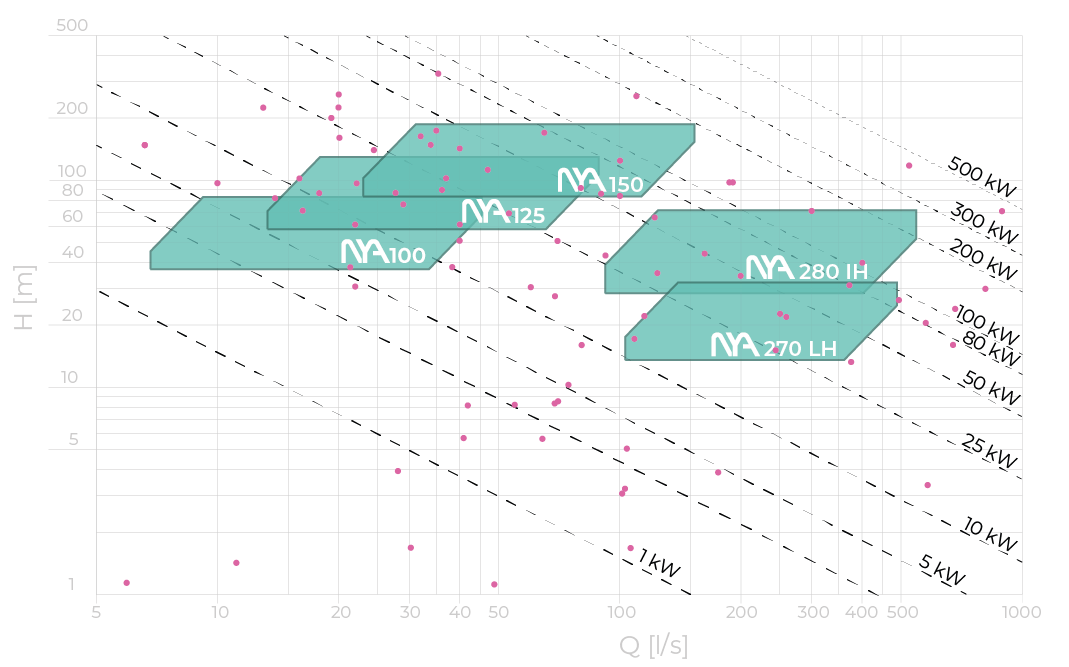
The NYA series is divided into three product families — HH (High Head), IH (Intermediate Head) and LH (Low Head) — optimised to operate under conditions characterised by increasing flow rates and decreasing heads. The range covers flow rates from 5 to 1000 l/s and heads from 5 to 500 m, with recoverable power from 1 kW up to 500 kW.
Each dot on the chart represents an actual installation point measured in Italian water distribution networks by Hydrovalue technicians — confirming that the NYA range is sized on real-world data, not theoretical assumptions.
Engineered for performance, built for consistency
The NYA Series is built as a true product line, engineered and repeatable. Compact flanged bodies slot into the pipeline, replacing valves with machines that regulate and generate simultaneously. Every model is validated to utility standards for durability and performance.
Smart Hydropower
The NYA turbine combines the efficiency of a real hydro turbine with the simplicity of a pump. Thanks to its guide vane regulation, it guarantees network stability upstream or downstream—while turning excess pressure into real, measurable kilowatt-hours of clean energy. Unlike traditional PRVs or Pump-as-Turbine solutions, NYA offers intelligent, adaptive regulation, driven by an electric servomotor that minimizes hydraulic transients and guarantees compatibility with drinking water standards. Thanks to its variable geometry and optional variable speed, the NYA turbine provides two degrees of freedom, achieving full coverage of operating conditions with maximum flexibility. Designed for water utilities but equally effective in traditional hydro plants, the NYA turbine combines compact design, high efficiency, and fail-safe operation, turning excess pressure into clean, renewable energy.
Dynamic control for real-world network conditions
Variable speed and incidence control extend performance far beyond conventional limits. Each turbine follows real network dynamics—morning peaks, night lows—while keeping downstream setpoints steady. Energy recovery remains significant across the full duty cycle.
Precision regulation for stable, efficient operation
Closed-loop regulation smooths pressure changes, dampening water hammer and reducing network stress. Efficiency envelopes, proven in laboratory tests, demonstrate robust energy recovery. The result is calmer hydraulics and consistent renewable output.
Intelligence that anticipates, not reacts
NYA integrates AI-based predictive maintenance through Motor Current Signature Analysis (MCSA), continuously monitoring the electrical signature of the generator to detect mechanical anomalies before they become failures. The native PLC records and stores operating data — vibration, temperature, speed, pressure — building a historical dataset used to anticipate maintenance needs, extend component life and reduce unplanned downtime. The result is a system that doesn't just generate energy and regulate pressure — it actively looks after itself, keeping the network running and maintenance teams informed.
Energy meets intelligence in water quality control
Multiparameter probes mounted under line pressure monitor chlorine, turbidity, pH, conductivity, and temperature. Data flow via Modbus into SCADA, giving utilities real-time assurance of water quality. Each turbine becomes both a generator and a monitoring station.
Installation

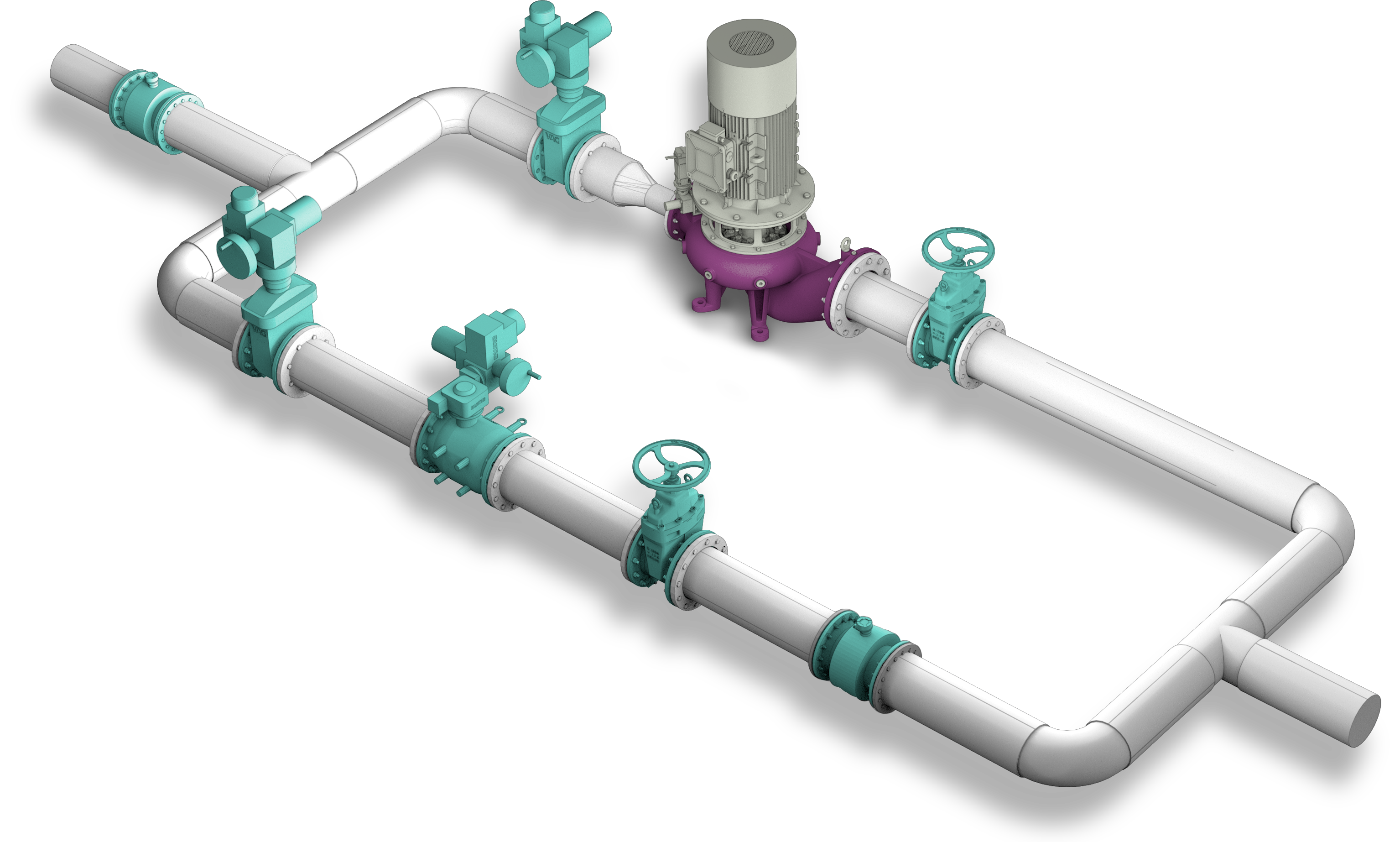
NYA is installed in-line with a bypass equipped with a PRV. The layout includes upstream and downstream actuated gate valves, a flow meter, a needle valve and pressure tapping points — requiring minimal modifications to the existing piping.
Overall dimensions

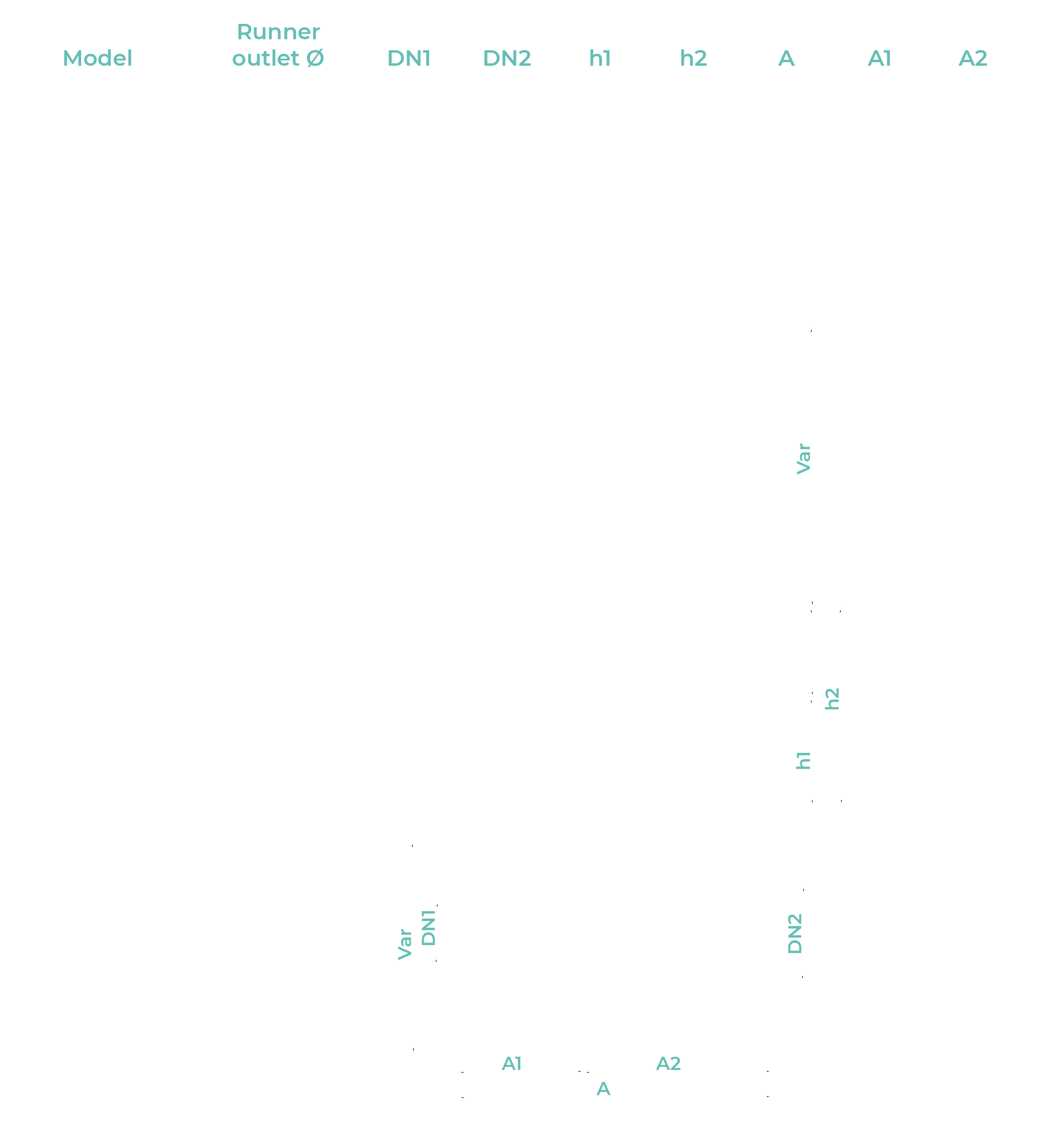
NYA turbine series overall dimensions — technical drawing with dimensional table for NYA100, NYA125, NYA150, NYA280 IH and NYA270 LH.
High differential head
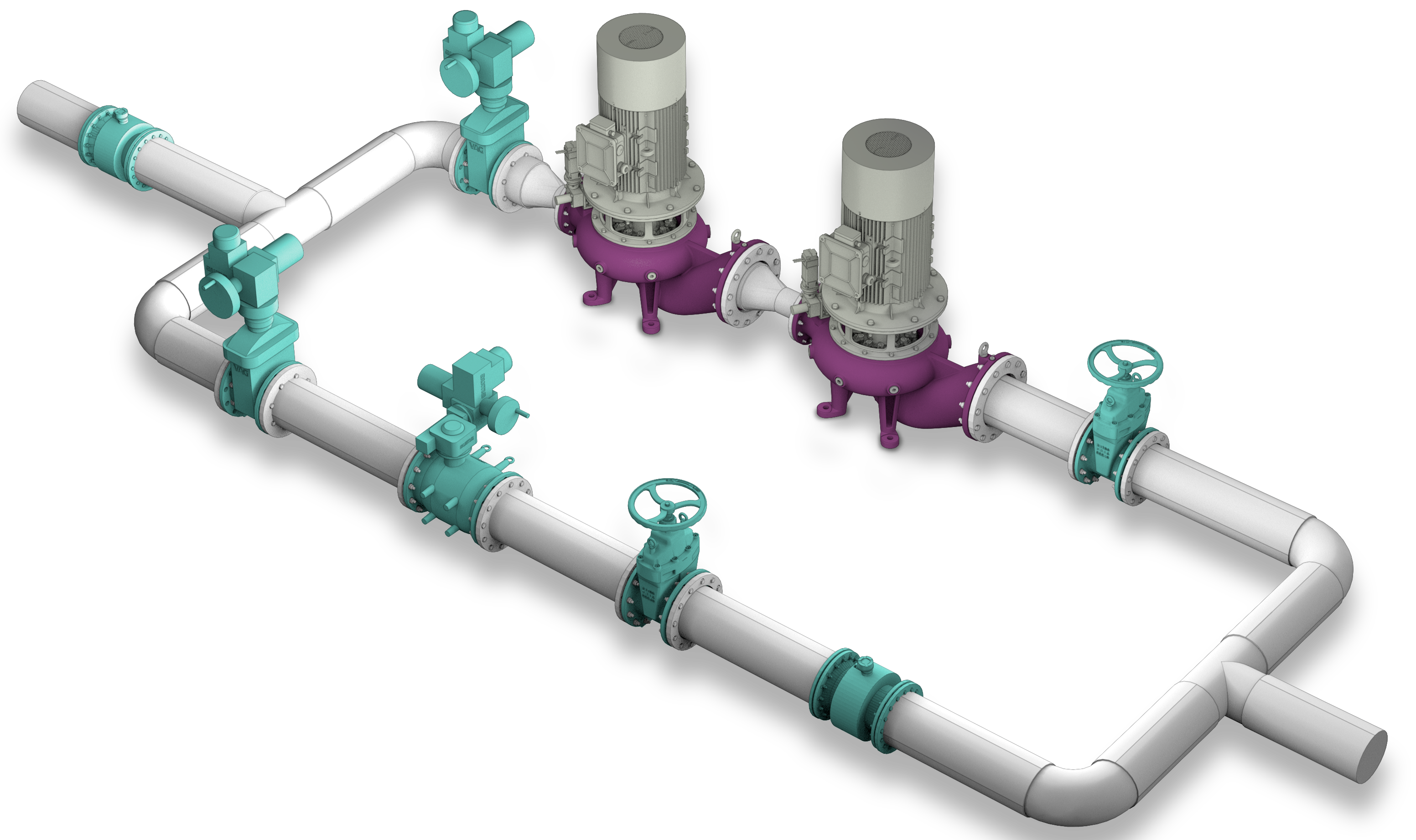
Multiple NYA units installed in series to handle high differential heads. When the turbine is out of service, the entire flow is diverted through the bypass and the original hydraulic configuration is fully restored.

High flow rates
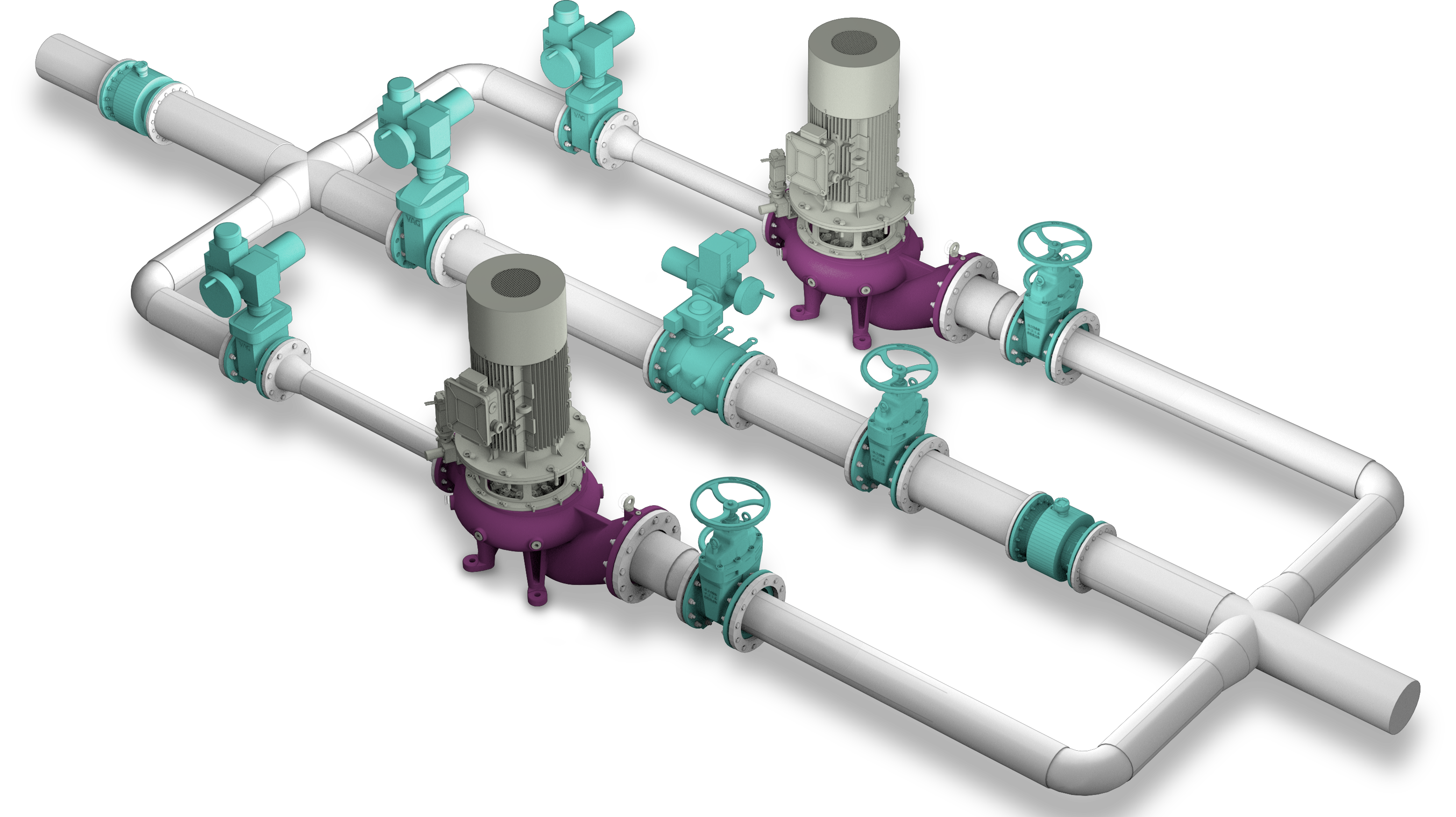
Multiple NYA units installed in parallel to handle higher flow rates while maintaining the same head. The modular architecture allows the system to adapt to wide operational variations of the network over time.

Green infrastructure
Energy node integrated into public green spaces and connected to the water network. It can power drinking-water dispensers and light charging services.

Smart city
Multifunctional urban structure that generates energy and integrates information displays and communication features.

Public Infrastructure
Energy node integrated into the urban water network to power smart street lighting, sensors, and distributed public services.

Smart mobility
Modular installation in parking areas with integrated charging for electric vehicles and smart services.

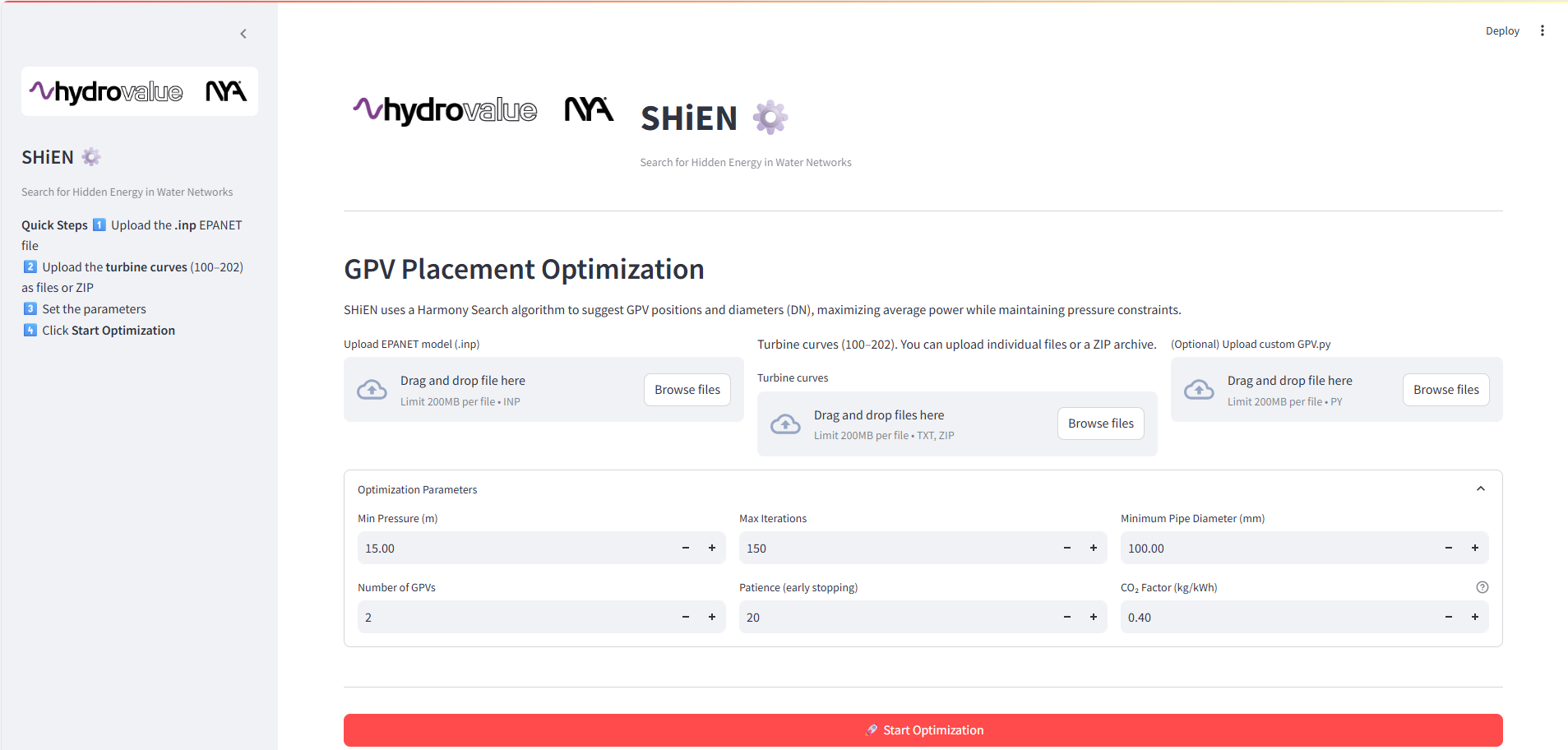
Integrated within water distribution networks, the SHiEN Tool combines hydraulic simulation and metaheuristic optimization to maximize recoverable energy. Using turbine performance curves, pressure, and flow data, candidate placements of General Purpose Valves (GPVs) are simulated in EPANET and scored against head constraints. A harmony search algorithm with adaptive HMCR/PAR dynamically evolves valve layouts, tracking convergence, patience, and diversification strategies. Results include optimal valve diameters, energy recovery potential, and CO₂ savings, with outputs visualized through convergence plots and stored in structured reports. This approach transforms passive networks into micro-hydropower assets, reducing energy losses while boosting sustainability.

SHiEN webapp